
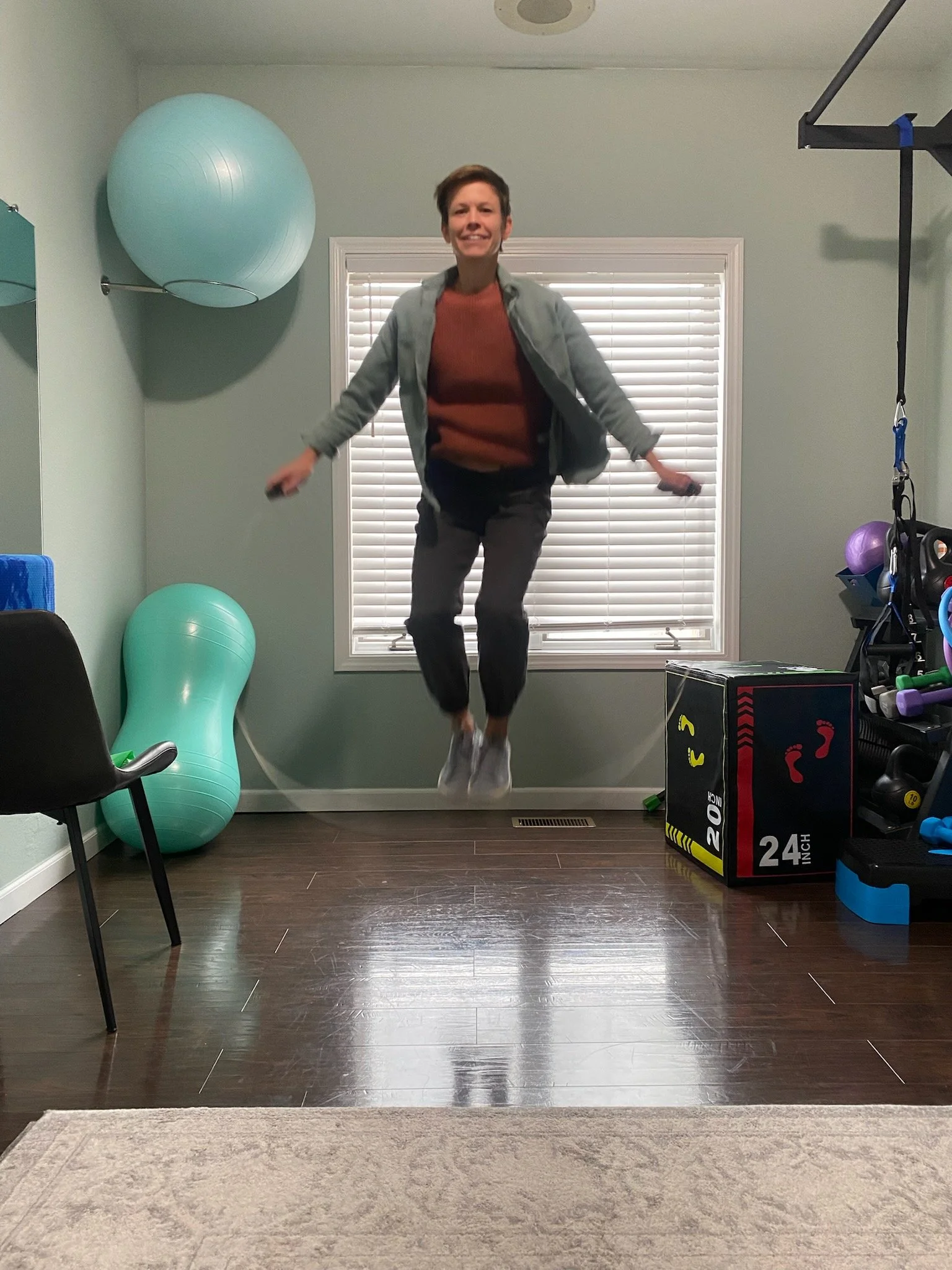
Dr. Michelle shows how much fun jumping rope can be!
One of our amazing patients asked us to write a blog post about stopping leaking while jumping rope. There has been a lot of information out about how jumping exercises are helpful, especially during perimenopause to help prevent bone loss, increase circulation, decrease swelling, and improve cardiovascular health. This is true not only during perimenopause, but in life.
Doing some form of exercise that involves jumping (think dancing, jumping on a trampoline, jumping rope, box jumps, hop scotch, skipping, running) is not only great for your body, but it can also make exercising more fun!
First, let’s look at what the pelvic floor needs to do when jumping. As you jump and land, you have something called a ground-reaction force. Your abdomen, pelvic floor, and joints need to respond to this force. Your pelvic floor muscles need to anticipate the landing, contract to support your organs, lengthen to be ready for the next jump, and coordinate its movement with the diaphragm, abdominal muscles, hips, and legs. Because of this, it is important that your pelvic floor as good coordination not just strength.
Next, let’s look at what happens to the female body during perimenopause. During perimenopause, estrogen changes and eventually declines which impacts your pelvic floor and the pelvic organs. You might see a change to the vaginal and vulvar tissues, the tissue around the urethra, the bladder, how the pelvic floor muscles function, the tissue that holds up and connects organs, the blood flow to the muscles, among many other changes in the body.
You might be fine jumping rope one day and then the next you all the sudden leak. This could be for many reasons.
A very “simple” reason is that maybe your pelvic floor strength needs to be improved. If this was the only reason, our jobs would be VERY easy. Usually there is much more to it.
Not only do your muscles need to have adequate strength, but they also need to have endurance. Again, if this was the reason, we would be out of jobs very quickly.
A lot of the time there is also a component to the coordination of the pelvic floor muscles. They need to be able to respond to that force when you land. They need to anticipate it and react appropriately.
There is also something called pressure management. This means that your pelvic floor and abdominal muscles need to work together so that your whole system has adequate support.
Breathing plays an important role in supporting your body during jumping. If you are holding your breath, you might be putting a lot of pressure on your pelvic floor.
What is happening at your hips and ankles plays an important role in how your pelvic floor can support you.
The position of your trunk is also important to help your pelvic floor be able to support you while you jump.
As you can see, there is much more that goes into not leaking while you jump than just the strength of your pelvic floor muscles. Someone could have a 5/5 pelvic floor muscle strength (basically the strongest muscles possible) and still leak.
All of the above is what needs to happen when jumping. When you add jumping rope into the mix you now have arm movement. This means that not only does your pelvic floor need to react to the force of landing, but it also needs to react to you moving your arms and swinging the rope around.
All of this is to say that there is so much more to not leaking while jumping rope than just “do pelvic floor contractions (aka kegels)”.
If you are leaking while jumping rope, or jumping, or really anytime for that matter, the things that need to be assessed are your core strength, your hip strength and range of motion, your ankle strength and range of motion, your coordination or your pelvic floor and your core, your ability to relax your muscles, how you breathe, how you manage the pressure in your body, how you land, what your are drinking and eating, your bowel movement habits, what your hormones are doing, and where your pelvic organs like to sit.
If you are experiencing leaking with jumping, try:
Before jumping, only drink water, rather than coffee, tea, soda which can all irritate the bladder.
Before jumping, take a few deep breathes to fully relax your pelvic floor and body.
Start with a couple of jumps rather than aiming to jump for several minutes.
While jumping, be sure to breathe. Do NOT hold your breath!
Try to land quietly. This will allow less impact on your body. It helps to think of landing on your toes.
Pay attention to when the leaking happens. Did you feel like you were going to leak before you actually leaked? How many jumps did it take before you leaked?
Pick a spot that is on the ground 20 feet in front of you to look at. This will help make sure that your rib cage is stacked over your ribs and that your ribs are not flared out which will help your pelvic floor be able to coordinate with your body better.
There is a lot of misinformation out there about needing to constantly do kegels, decrease your water intake, pee more often, hold your breath while you are exercising, stop exercising if you leak, all women will leak. These are all not true. If you have any questions about these please reach out to us by clicking the button below. If you find yourself leaking, please reach out. This is very common, but not normal and it should NOT become your new normal.
