
Endometriosis: You Are Not Alone
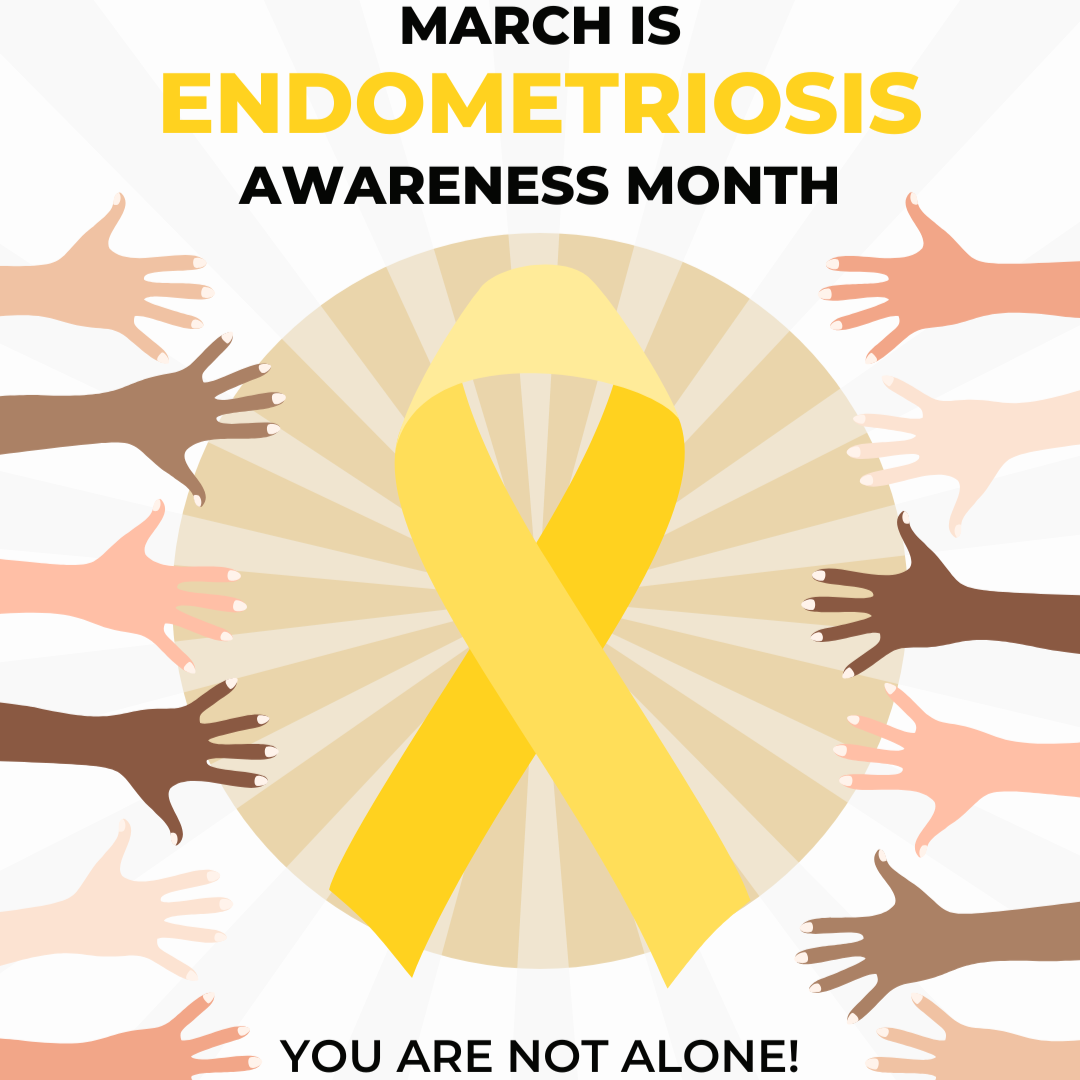
March is Endometriosis Awareness Month. Did you know that 1 in 10 women suffer from endometriosis?
Many teenagers miss school because of their “bad cramps” or heavy bleeding. They are told to go on birth control and to take ibuprofen. If you have endometriosis, taking ibuprofen won’t do very much for the pain so you might continue to miss out on activities. We, as women, are expected to live our regular lives and “deal” with the pain and heavy bleeding. This is NOT normal. Pain from endometriosis is not pain that anyone should have to just “put up with”.
Most people who have endometriosis see 7 medical professionals before they are diagnosed with endometriosis.
Endometriosis happens when tissue from the uterus grows outside the uterus. It has been found on the organs around the uterus, but it has also been found on other organs even the lungs and brain. During menstruation, tissue in the uterus leaves the body from the uterine lining shedding (aka bleeding during your period). This tissue that grows outside of the uterus has no way to exit the body which can cause increased inflammation and pain.
There are many symptoms associated with endometriosis. Some common symptoms include:
Painful periods
Chronic pelvic pain
Pain with intercourse
Pain with bowel movements or urination
Bloating (“endo belly”)
Fatigue
Fertility challenges
However, there are many other symptoms as well. In fact, I had a patient one time who had tailbone pain only during her period. She got minimal relief of her pain from pelvic floor therapy, so I had her see an endometriosis specialist who diagnosed her with endometriosis. Once she was treated for that, her tailbone pain went away.
As you can see everyone experiences endometriosis differently. Some people have a lot of endometirosis, but only have mild symtoms. While other people have very few endometriosis lesions, but have severe symptoms.
How does all this relate to the pelvic floor?
The pelvic floor muscles like to protect the body. They sometimes contract due to the pain that is experienced with endometriosis to “protect” you from pain. Unfortunately, this can lead to increased pelvic floor tension, decreased coordination in the muscles, and/or muscles that are over-gaurding from pain.
Pelvic floor physical therapy can help to relax the pelvic floor muscles. Pelvic floor therapists trained in visceral mobilization can also work on the uterus, rectum and bladder to help decrease the pain associated with endometriosis in those areas.
At Insight Pelvic Health, we take a whole-person approach. While pelvic floor therapy does not “cure” endometriosis, it can significantly reduce pain and improve quality of life.
We help the pelvic floor muscles relax.
We do hands on, external, and internal manual therapy to help the muscles relax. Then we teach you ways to help the pelvic floor muscles relax when you are at home.
We do work to help increase the blood flow and tissue mobility in your pelvic floor and other areas of your body.
We do this with visceral mobilization and manual therapy. This helps to decrease scar tissue and adhesions which might be restricting movement. This also helps to improve mobility and decreases pulling and pressure sensations you might be experiencing.
We help to calm your nervous system which will help to decrease your pain.
We address the whole body and it is important that we are working with your nervous system to help the muscles relax and to help your pain decrease. We will give you things you can do at home to help with this as well.
Endometriosis is a complex condition and requires a team approach. We collaborate and coordinate you care with other members on your team. We recommend having an endometriosis specialist, an acupuncturist, a mental health therapist, a dietician, and others.
It is very important that you know that YOU ARE NOT OVERREACTING and YOU ARE NOT MAKING IT UP.
Endometriosis in an “invisible” disease so it is easy to be dismissed for your symptoms. We empower you to find providers that believe you and want to help you. Severe pain is not something you need to “just push through” or “deal with”. If your symptoms are interferring with your quality of life, PLEASE SEEK HELP! You deserve support and care!
If you have not found a provider to help you, please click the button below. We would love to work with you and help guide you to a team of providers! You don’t have to navigate endometriosis alone.
